[ad_1]
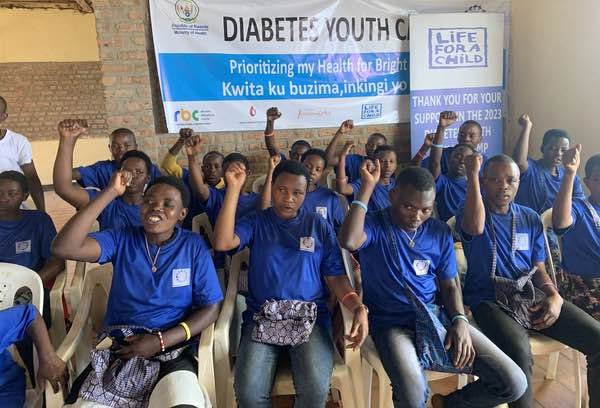
A partial view of learners
Gakoni (Kiziguro): Delphine Nibarere, 21, is a young girl from Kansi, Gisagara district in the south of the country. Valence Iradukunda, 24, is a young man from Bugarama, Gisagara district, in the West Province. These two have in common the disease of diabetes.
This is why they are in the Gakoni Center founded by François Gishoma for the purpose of organizing training to provide knowledge aimed at helping young people with diabetes to live with this disease.
Nibarere and Iradukunda are part of the first contingent of 74 young people sent by various hospitals in the country to follow the training for a week, from July 16 to 22. It is planned to organize six such camps in the country this year. The Association Rwandaise des Diabétiques (ARD) or Rwanda Diabetics Association (RDA) is supported in this action by RBC (Rwanda Biomedical Center), WDF World Diabetes Foundation), LFAC (Life For Child), Insulin Zum Leten, and Rwanda NCD Alliance (Rwanda Non Communicable Diseases Alliance).
The Gakoni site which hosts these young people is located in Kiziguro Sector, Gatsibo district. It overlooks Lake Muhazi. It has a pleasant view that allows these young people to relax while learning vital lessons to sustain themselves.
Each case of diabetes for each of the young people approached is a separate story. An individual experience with a particular context. Diagnosing diabetes for young people took time for everyone. But when the doctor finds the disease, it’s a real relief, because at least you don’t know what drugs and what precautions to take to stay alive.
It is here that the itinerary of each young diabetic constitutes a testimony to instruct other young people and the public in general.
trainer Mbonyi facilitating the session
Nibarere was at the Common Core in Kansi. His state of health intrigued the educators. Because, she was not healing quickly to keep up with the other students in their daily exercise. Transferred to a district hospital, a doctor will diagnose her with diabetes, and will prescribe medication and a diet to follow. It was the beginning of a hope. Because, the prescribed drugs, the recommended diet, and the advice given, allowed Niberere to return to school and complete the entire secondary cycle, even if his results were not good enough to benefit from a government scholarship.
Iradukunda interrupted his schooling when he was in the 5th year of secondary school. His health began to decline when he lost his mother, and the father abandoned the orphans to live elsewhere with a new wife.
Hard life, hunger, lack of food and proper diet may have been the cause of Iradukunda’s diabetes. One day, he collapses and is taken to the hospital where he is resuscitated. Tests confirm diabetes. The medications and advice given have enabled Iradukunda to take responsibility for herself and to know how to live with diabetes.
“I have to build my life. I know how to take care of myself. I live in a house that I rent. I take a diet. I live with my diabetes. The training received at Gakoni comforts me and helps me lead a normal life while working. The young people I met in Gakoni showed me that I am not alone. Our exchange of experiences teaches me a lot and keeps me united with the group. There is hope in my life in the community,” he says.
For the trainer of the group, Paul Mbonyi of RDA, the objective of the workshop is to help these young people to accept their diabetes and to live well with the disease.
Delphine Nibarere, the Valence Iradukunda learner
“The workshop shows that you can live with your diabetes throughout your life, while carrying out your professional life properly. You can start a home and have children. The main thing is to know how to take care of yourself. Because, the diabetic is the first doctor of himself. The workshop gives guidelines so that the diabetes does not worsen to take the life of the patient. The other aspect of the training is sexual and reproductive health, including protection against HIV/AIDS. These are young people who must avoid drug use. They must find answers within themselves, initiate income projects to live self-sufficiently,” he says.
At the end of the campus, the campus organizes entertainment sessions to create more conviviality and hope for the future. The individual should not live in isolation. Because it belongs to the community. Thus, one must drive out the prejudices according to which the diabetic cannot have children or cannot have sexual intercourse.
By way of a message, Paul Mbonyi points out that diabetes, especially type one diabetes, is a disease that does not cure, and that we must carry throughout life. It is this diabetes from which the young people of the Gakoni camp suffer. Fortunately, we have drugs to keep the necessary amount of sugar in the body. No need to feel guilty for having diabetes. Because having diabetes does not mean that life is over. The important thing is to know how to live with your illness, continues the trainer Mbonyi. The important thing is to follow the guidelines given in order to continue living with your diabetes for as long as possible.
For this, we respect the program of taking medication, respecting appointments with the doctors, knowing how to do tests to see if we do not have opportunistic diseases when we suffer from diabetes for a long time. These diseases are kidney disease, blindness, hypertension, cardiovascular disease, etc.
But also one must follow the recommended diet focused on whole and rich foods such as vegetables, because vegetables do not allow sugar to enter the body quickly. (END)
Related
[ad_2]
Source link
About the Author